
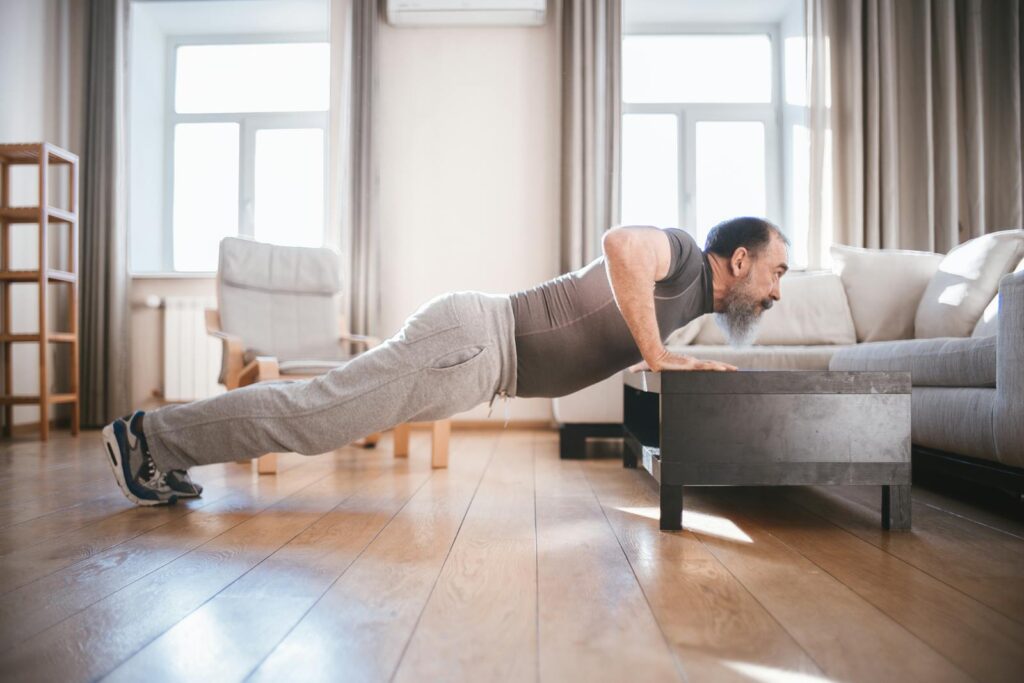
The beauty of using bodyweight exercises to stay fit without equipment lies in their simplicity and accessibility. Every push-up, squat, and plank performed is not just a testament to physical strength but an empowering reminder that your body has everything it needs to thrive. Whether you’re a busy professional, a parent juggling multiple responsibilities, or someone who simply enjoys the convenience of working out at home, these exercises are your ticket to a healthier lifestyle without any barriers.
Statistics reveal that only about 23% of Americans work out regularly, often citing lack of time and resources as primary obstacles. With bodyweight exercises, those excuses fade away, opening a world of possibilities for maintaining fitness. Picture this: you’re on vacation, miles away from the nearest gym, or perhaps caught in a hectic work schedule. Instead of sacrificing your fitness routine, you embrace the power of push-ups, lunges, and burpees right where you are.
It’s not just about building strength, it’s about building resilience and adaptability. In this blog post, we’ll explore how you can harness this potential and weave exercise seamlessly into your daily life, regardless of where you find yourself.
Benefits of Bodyweight Exercises
Using bodyweight exercises to stay fit without equipment offers a host of advantages that make them an ideal choice for anyone looking to improve their health. First and foremost, these workouts require zero gear, allowing you to exercise anywhere—at home, in a park, or while traveling. This accessibility removes the financial and logistical barriers often associated with gym memberships and bulky machines. Additionally, bodyweight movements engage multiple muscle groups at once, promoting functional strength and coordination.
By relying on compound motions like squats, push-ups, and lunges, you build balanced muscle development and improve overall mobility. Another key benefit is scalability. Whether you’re a complete beginner or an advanced athlete, bodyweight exercises can be modified to match your fitness level. Beginners might start with knee push-ups and assisted squats, while experienced exercisers can progress to one-arm push-ups and pistol squats. Furthermore, these workouts often incorporate core activation and stability work, which enhances posture and reduces the risk of injury in everyday activities.
Lastly, the convenience of quick, equipment-free sessions makes it easier to maintain consistency—one of the most important factors for long-term fitness success.
Basic Bodyweight Exercises for Beginners
Starting your journey with simple, foundational movements will set the stage for sustainable progress. These basic bodyweight exercises help you develop proper form, build initial strength, and increase confidence in your abilities. Consistency and attention to technique during this phase will pay dividends as you advance to more challenging routines.
Begin with the following five exercises, aiming for two to three sets of 8–12 reps each. Focus on controlled movements, full range of motion, and intentional breathing. As you grow stronger, you can slowly increase your repetitions or add a third set to continue challenging your muscles.
1. Squats
Squats are the cornerstone of lower-body bodyweight training, targeting the quads, hamstrings, glutes, and core stabilizers. To perform a proper squat, stand with feet hip-width apart and toes pointing slightly outward. Engage your core, keep your chest lifted, and push your hips back as if sitting into a chair. Lower your body until your thighs are parallel to the ground, ensuring your knees stay aligned over your toes. Press through your heels to return to standing, squeezing your glutes at the top.
For beginners, practicing with slow, deliberate tempo helps cement good form. Pause for a second at the bottom to maximize muscle engagement. Over time, you can increase the depth of your squat and the tempo of your reps. Variations like sumo squats (wider stance) or pulse squats (small up-and-down movements at the bottom) add variety and emphasize different muscle fibers.
2. Push-ups
Push-ups are an excellent upper-body and core exercise, working the chest, shoulders, triceps, and stabilizing muscles of the midsection. Begin in a plank position with hands slightly wider than shoulder-width. Keep your body in a straight line from head to heels, avoid sagging hips, and look down to maintain a neutral neck. Lower your chest toward the floor by bending your elbows, then press back up to full extension.
If standard push-ups are too challenging at first, start with knee push-ups. Maintain a straight line from your head to your knees, lower your chest, and push back up. As you build strength, transition to incline push-ups—placing your hands on a bench or sturdy chair—to gradually adapt to the full movement. Focus on slow, controlled repetitions to enhance muscular endurance and joint stability.
3. Planks
The plank is a fundamental core exercise that engages the abdominals, lower back, glutes, and shoulders. Start face down on the floor, then lift onto your forearms and toes. Position your elbows directly under your shoulders and maintain a straight line from head to heels. Tighten your core and glutes to prevent your hips from sagging or hiking upward.
Hold a standard forearm plank for 20–30 seconds, gradually increasing the duration as your endurance improves. For variation, try side planks to emphasize the obliques—support your body on one forearm with feet stacked or staggered, and lift your hips toward the ceiling. Plank holds develop deep core stability that translates into better posture, reduced back pain, and enhanced performance in other exercises.
4. Glute Bridges
Glute bridges primarily target the glutes and hamstrings, while also engaging the lower back and core stabilizers. Lie on your back with knees bent, feet flat on the ground hip-width apart, and arms by your sides. Press through your heels to lift your hips toward the ceiling, forming a straight line from shoulders to knees. Squeeze your glutes at the top, pause briefly, then slowly lower back down.
This exercise improves hip extension and strengthens the posterior chain, which is critical for proper running mechanics, posture, and injury prevention. To increase difficulty, perform single-leg glute bridges—extend one leg straight while lifting your hips with the other. Focus on controlled movements and avoid overarching your lower back to keep the tension in the glutes.
5. Lunges
Lunges are dynamic unilateral movements that enhance balance, coordination, and lower-body strength. Stand tall with feet hip-width apart. Take a large step forward with one foot, and lower your body until both knees are bent at approximately 90 degrees. Ensure your front knee doesn’t extend past your toes. Push through the front heel to return to standing, then repeat on the opposite side.
You can perform walking lunges, reverse lunges, or static split squats (staying in position and lowering up and down) to vary the stimulus. Keep your torso upright and core engaged throughout. Lunges not only build strength but also improve stability by forcing each leg to work independently, correcting imbalances and promoting symmetrical muscle development.
Intermediate Bodyweight Exercises to Amp Up Your Workout
Once you’ve mastered the basics, it’s time to add intensity and variety. Intermediate bodyweight exercises challenge your muscles in new ways, increasing strength, endurance, and mobility. These moves often demand greater coordination and core stability, pushing you out of your comfort zone.
Incorporate the following four exercises into your routine. Aim for three to four sets of 8–15 reps, focusing on controlled form and full range of motion. Rest 60–90 seconds between sets to maintain optimal performance and prevent fatigue.
Advanced Bodyweight Exercises for Strength and Endurance
For seasoned athletes or those seeking a formidable challenge, advanced bodyweight exercises push your limits by requiring explosive power, heightened balance, and exceptional core control. These movements unlock new strength gains and enhance overall athleticism.
Advanced exercises often combine multiple muscle groups and demand greater joint mobility. Introduce these moves gradually, ensuring adequate warm-up and mobility work. Perform two to three sets of 5–12 reps, with 90–120 seconds rest to maximize performance and reduce injury risk.
Creating a Bodyweight Exercise Routine
Designing a structured routine ensures you consistently target all major muscle groups and progress over time. A balanced plan typically includes lower-body, upper-body, and core exercises, along with mobility and cardiovascular components. Strive for three to five workouts per week, varying intensity and volume to prevent plateaus.
One effective approach is the push/pull/leg split or full-body circuits. For example, on push days focus on push-ups, dips, and shoulder variations; on pull days include inverted rows and bodyweight biceps curls; and leg days cover squats, lunges, and glute bridges. Circuit-style workouts combine strength and cardio, cycling through exercises with minimal rest for a time-efficient, full-body challenge.
Tracking Progress and Setting Goals
Monitoring your improvements keeps you motivated and accountable. Record the number of reps, sets, and exercise variations each session. Note how you feel—energy levels, perceived difficulty, and recovery. Over weeks, compare your data to identify trends and adjust your workouts accordingly.
Set SMART goals—Specific, Measurable, Achievable, Relevant, and Time-bound. Instead of “get stronger,” aim for “perform 20 full push-ups by the end of eight weeks.” Celebrate milestones along the way, whether it’s adding reps, mastering a new variation, or improving overall workout consistency. Regular reflection and goal adjustment drive continuous progress.
Incorporating HIIT with Bodyweight Exercises
High-Intensity Interval Training (HIIT) pairs perfectly with bodyweight movements, delivering maximum calorie burn and cardiovascular benefits in minimal time. A typical HIIT session alternates short bursts of intense effort with recovery periods, keeping your heart rate elevated throughout.
Design a HIIT workout with five to eight exercises—like burpees, squat jumps, mountain climbers, and high knees. Perform each move for 30–45 seconds at maximum effort, followed by 15–30 seconds of rest. Complete three to five rounds, resting one to two minutes between circuits. HIIT workouts can be as brief as 15 minutes yet produce lasting metabolic effects.
Nutrition Tips to Support Your Bodyweight Training
Fueling your body appropriately is crucial for strength gains, recovery, and overall performance. Focus on balanced meals with lean proteins, complex carbohydrates, and healthy fats. Protein sources like chicken, fish, beans, and Greek yogurt support muscle repair, while whole grains and starchy vegetables provide sustained energy for tough workouts.
Stay hydrated by drinking water throughout the day and around your exercise sessions. Incorporate nutrient-dense snacks—such as fruit with nut butter or a protein smoothie—to maintain energy levels. Finally, prioritize sleep and stress management, as both significantly impact recovery and progress in your bodyweight training journey.
Overcoming Common Challenges with Bodyweight Workouts
Bodyweight training is accessible but not without hurdles. Plateaus, workout boredom, and time constraints can derail progress. To counteract these challenges, continually vary your exercises by adjusting tempo, reps, or leverage. For instance, try slow eccentrics (lowering phases) to increase time under tension.
Combat boredom by exploring new movement patterns—animal flows, yoga-inspired holds, or calisthenics skills like handstand progressions. If time is limited, micro-workouts of five to ten minutes scattered throughout the day can accumulate significant benefits. Remember, consistency trumps occasional marathon sessions.
Embracing the Freedom of Bodyweight Fitness
Embracing bodyweight training means embracing freedom: the freedom to work out anytime, anywhere, without the constraints of equipment or gym schedules. Through progressive challenges and creative variations, you can continuously develop strength, endurance, and flexibility.
By combining structured routines, goal setting, HIIT bursts, and smart nutrition, you’ll not only stay fit but thrive in your fitness journey. Remember, your body is the most versatile tool you’ll ever own—use it wisely, consistently, and with confidence.